Wednesday, April 15, 2026
The Death of the Software Developer Has Been Greatly Exaggerated

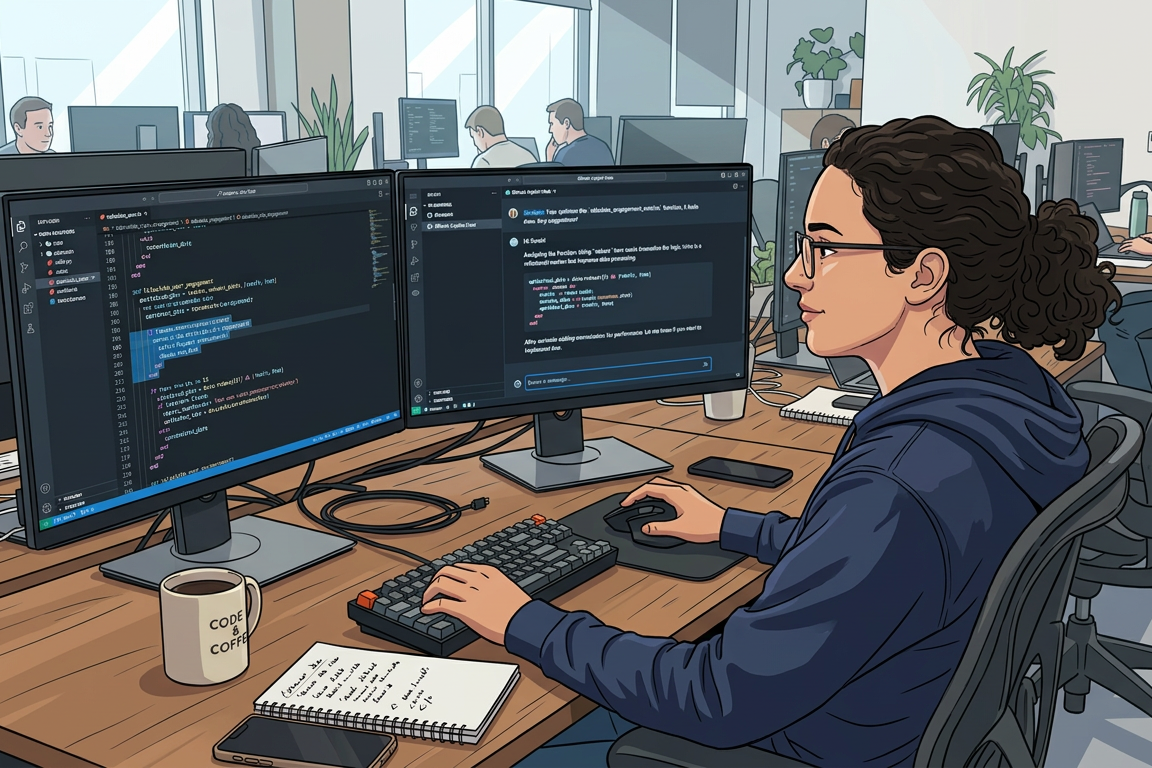
AI produces output. Engineers make decisions. That distinction matters more than most people outside the industry realize.
Every few years, someone announces that developers are obsolete.
In the 90s, it was visual programming tools. In the 2000s, it was offshore outsourcing. In the 2010s, it was low-code/no-code platforms. Now it's AI — and the eulogies are getting louder.
There's just one problem: the funeral keeps getting cancelled.
AI Can Write Code. It Cannot Think in Systems.
Here's what AI is genuinely good at: generating boilerplate, autocompleting functions, explaining unfamiliar syntax, and producing a working first draft of something simple. That's real and useful.
Here's what it cannot do: understand that the payment service talks to three legacy microservices held together with duct tape and good intentions, that the CTO made a promise to a client last Tuesday that changes the data model, and that the "quick fix" someone is about to deploy will quietly corrupt six months of financial records.
Software is not code. Software is decisions made under constraint, inside organizations, with real consequences. AI produces output. Engineers make decisions.
That distinction matters more than most people outside the industry realize.
More Tools, More Demand — Every Time
There's a concept in economics called induced demand. Build more highways, and more people drive. Make something easier and cheaper to produce, and consumption goes up, not down.
Software is no different.
When spreadsheets arrived, accountants didn't disappear — demand for financial analysis exploded. When cloud computing made infrastructure cheap and accessible, the number of software companies didn't shrink — it ballooned. When no-code tools promised to replace developers in the 2010s, the number of software developer job postings went up by double digits year after year.
AI is the most powerful developer productivity tool ever built. Which means we are about to see an explosion in the amount of software being created, deployed, and — critically — maintained. Every new system needs someone to design it, someone to own it, and someone to fix it when it breaks at 2am.
That someone is not ChatGPT.
AI-Generated Code Still Has to Work in the Real World
Pull up any AI-generated codebase and spend twenty minutes with it. It looks clean. It's often structurally reasonable. And it will, with impressive regularity, contain subtle bugs, security vulnerabilities, and architectural decisions that will cause serious pain eighteen months from now.
AI doesn't know your production environment. It doesn't know your traffic patterns, your compliance requirements, your team's capabilities, or the three things your CTO is terrified of. It generates plausible-looking code based on patterns from millions of codebases — including millions of bad ones.
Someone has to review that output. Someone has to catch the injection vulnerability the model confidently introduced. Someone has to recognize that the generated authentication flow doesn't meet the security standards your enterprise clients contractually require.
The more AI-generated code floods into production systems, the more critical it becomes to have engineers who can read it, audit it, and know when to throw it away.
The Floor Rises. The Ceiling Goes Higher.
Here's the honest version of what AI is changing: the floor for entry-level work is rising. Tasks that once kept junior developers busy — writing CRUD endpoints, generating data migrations, scaffolding tests — are increasingly handled by AI tools.
That does raise the bar for getting started in the field. It's worth saying plainly.
But here's what it does to the ceiling: it removes the ceiling entirely.
A senior engineer with AI tools can now build what used to require a team. An architect can prototype in days what used to take weeks. A small engineering organization can now deliver software at a scale that was impossible five years ago.
The leverage available to a genuinely skilled software engineer in 2025 is unlike anything the industry has seen before. Which is another way of saying: the best engineers in the world just became significantly more valuable, not less.
The Hard Problems Are Still Hard
AI has not made distributed systems easier to reason about. It has not simplified the challenge of migrating a fifteen-year-old monolith to microservices without taking down production. It has not made it easier to design APIs that will still make sense when your user base is 100x what it is today.
The genuinely difficult problems in software — the ones that drive real business value — are problems of architecture, judgment, and experience. They require someone who has been burned before, who knows what "this seems fine" looks like before it isn't, and who understands that the best code is often the code you decide not to write.
Those problems are not getting simpler. If anything, as software becomes easier to create, the volume of complex systems that need experienced oversight will grow faster than the supply of engineers who can provide it.
What Actually Changes
The role evolves. It always has.
Developers who treat AI as a threat will struggle. Developers who treat it as a power multiplier — who learn to prompt well, review critically, architect intelligently, and focus their attention on the problems AI genuinely cannot solve — will be extraordinary.
The job title might look the same. The output will be different in scale. And the demand for people who can actually think about software — not just produce it — will continue to outpace supply.
The eulogies were premature. Again.
Frequently asked questions
Continue Reading