Wednesday, March 11, 2026
Shopify vs WooCommerce (2026): Which Ecommerce Platform Actually Wins?

Shopify is built to reduce complexity. WooCommerce is built to expose it.
Choosing between Shopify and WooCommerce is one of the most common decisions entrepreneurs face when launching an online store. Both platforms are powerful, but they take fundamentally different approaches to ecommerce.
Every year, hundreds of new articles attempt to answer the same question:
Shopify or WooCommerce?
Most of them follow the same tired format. They line up features, count plugins, compare pricing tiers, and declare a winner like it’s a boxing match.
But that approach misses the real issue.
The truth is that by 2026, both platforms are incredibly capable. They can sell products, handle payments, manage inventory, run promotions, and integrate with marketing tools.
So the real question isn’t:
Which platform has more features?
The real question is:
Which platform makes your business easier to run and scale?
When you frame it that way, the answer becomes far more interesting.
And sometimes… unexpected.
Shopify vs WooCommerce: Quick Comparison
| Feature | Shopify | WooCommerce |
|---|---|---|
| Platform Type | Managed ecommerce platform | Open-source WordPress plugin |
| Ease of Setup | Very easy | Moderate |
| Customization | Structured customization | Deep customization |
| Hosting | Included | Requires hosting |
| Security | Managed by Shopify | User-managed |
| Maintenance | Low | Moderate to high |
| Best For | Fast launches and small teams | Custom builds and complex stores |
| Typical Cost | Subscription | Variable infrastructure costs |
Shopify powers millions of ecommerce stores worldwide, while WooCommerce remains the most widely used ecommerce plugin for WordPress.
The Real Divide: Simplicity vs Control
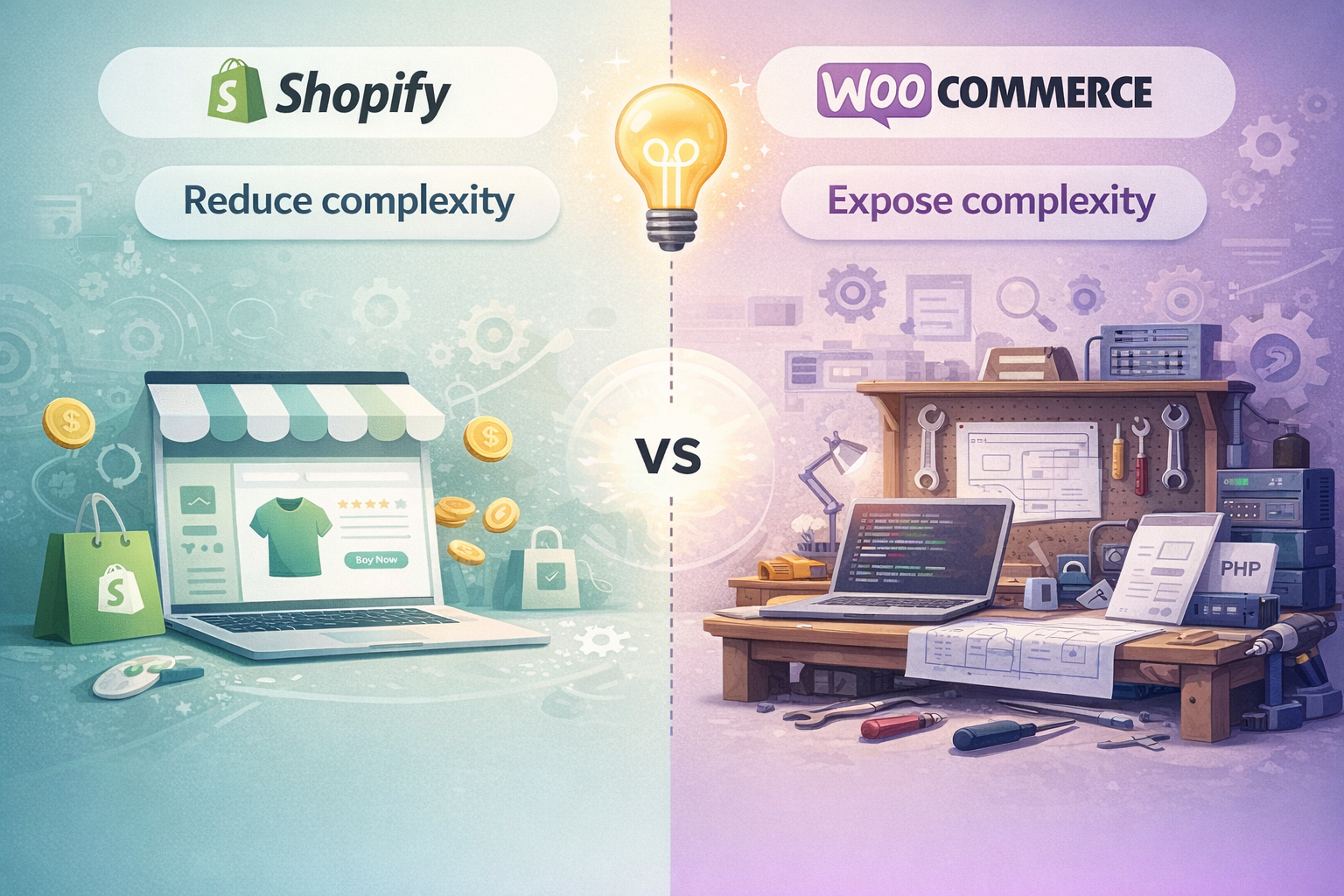
Shopify and WooCommerce represent two completely different philosophies about how ecommerce should work.
Shopify is built around operational simplicity.
WooCommerce is built around architectural freedom.
You could think of it like this:
- Shopify tries to remove as many technical decisions as possible.
- WooCommerce gives you the ability to make almost every decision yourself.
Neither approach is inherently better.
But one will align much better with how your business actually operates.
Why Shopify Wins for Many Businesses
Shopify has quietly evolved into something more than an ecommerce platform.
It’s becoming a commerce operating system.
Hosting, security, scaling, payments, checkout infrastructure, and updates are all handled for you. Shopify keeps tightening and refining the ecosystem so that merchants spend less time worrying about infrastructure and more time selling.
That matters more than it used to.
The bottleneck in ecommerce used to be building the store.
Today the bottleneck is running the business.
Marketing. Ads. Fulfillment. Customer service. Product development. AI tools. Content. Analytics.
The last thing most founders want is to spend hours debugging a plugin conflict or managing server performance.
Shopify solves this problem by compressing the entire technical stack into something that “just works.”
For businesses that want to move quickly, that simplicity is incredibly powerful.
Shopify tends to work best when:
• The business is founder-led
• Speed matters more than customization
• The team is small
• Technical resources are limited
• Stability and uptime are critical
In other words:
Shopify lets you focus on commerce instead of technology.
For many brands, that is exactly what they need.
Why WooCommerce Still Has a Massive Advantage
But here’s where things get interesting.
Not every ecommerce business behaves like a typical store.
Some businesses start to look more like platforms.
Content sites. Directories. Membership ecosystems. Hybrid service models. Education businesses. Marketplaces. Communities.
And when that happens, WooCommerce often becomes the better tool.
WooCommerce runs inside WordPress, which means you inherit the full power of the world’s most flexible content platform.
You’re not just running a store.
You’re running an entire digital ecosystem.
WooCommerce tends to shine when:
• Content and commerce are tightly connected
• SEO and content marketing drive growth
• The buying experience needs to be customized
• The business model is unusual
• The company has technical capability
WooCommerce doesn’t try to protect you from complexity.
It hands you the toolbox and says:
“Build whatever you want.”
For the right businesses, that freedom is priceless.
The Cost Conversation Is Often Backwards
You’ll often hear people say:
“WooCommerce is cheaper because it’s free.”
That statement is technically correct and strategically misleading.
WooCommerce core is free.
But running a WooCommerce store typically involves:
• Hosting
• Security
• Performance optimization
• Plugin licenses
• Maintenance
• Development work
None of those are free.
Shopify, on the other hand, bundles many of those costs into a monthly subscription.
Which means the real comparison looks more like this:
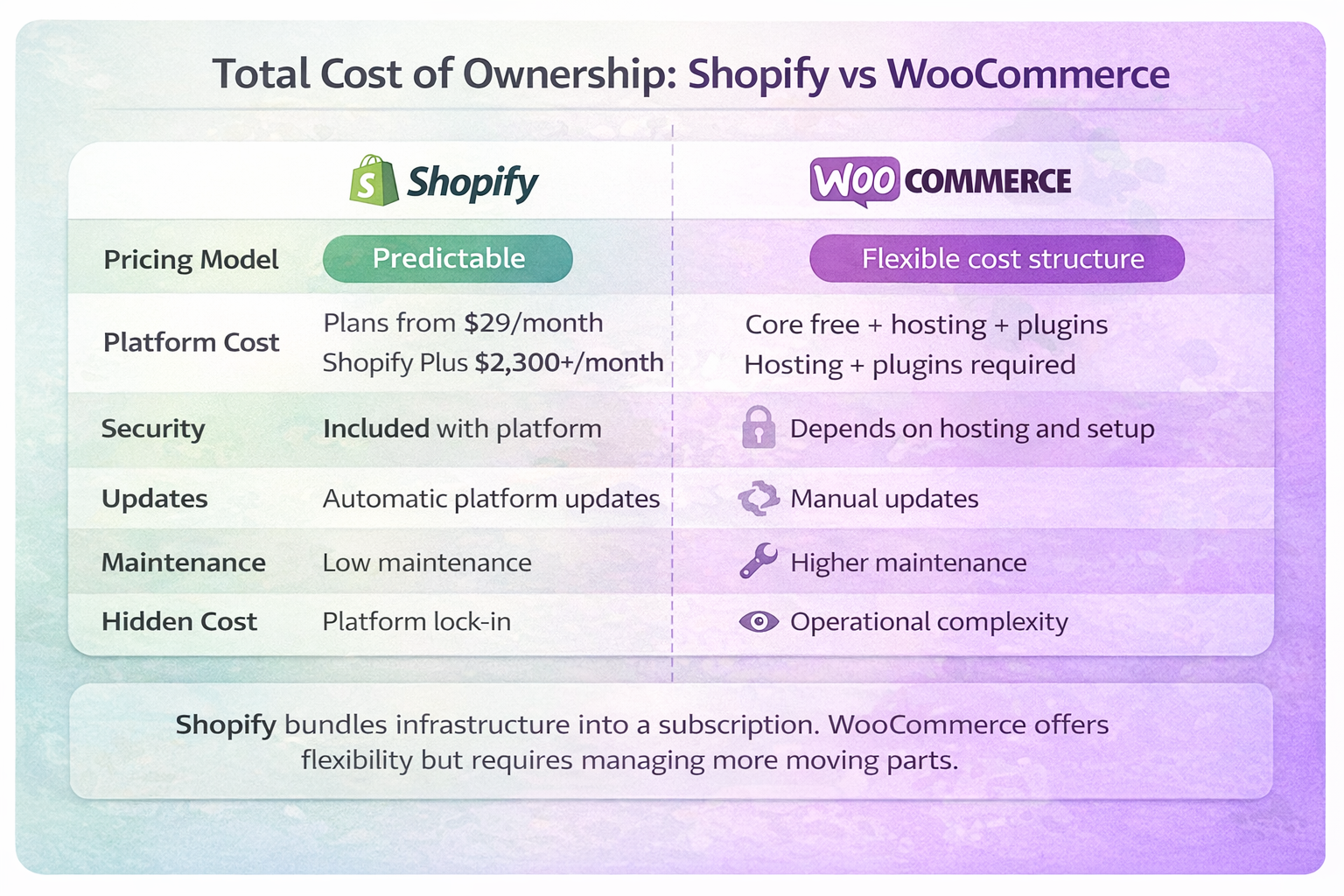
Shopify: predictable cost, limited complexity
WooCommerce: flexible cost, unlimited complexity
For a non-technical business owner, Shopify is often cheaper in the long run because fewer things break and fewer decisions require outside help.
For a technically capable company, WooCommerce can become dramatically more cost-effective because the business can shape the platform exactly to its needs.
The visual below shows how most businesses can decide between Shopify and WooCommerce based on overall price.
AI Is Changing the Landscape
AI is beginning to reshape ecommerce platforms in surprising ways.
But instead of making platforms more similar, it’s actually amplifying their differences.
On Shopify, AI tools are increasingly focused on helping merchants run their stores more efficiently. Shopify’s Sidekick assistant and growing automation tools are designed to help non-technical users make better decisions faster.
Shopify is trying to make the platform smarter.
WooCommerce takes a different path.
Because it’s open and flexible, AI can be woven into nearly any part of the stack. Developers can integrate AI into marketing workflows, SEO automation, content generation, product recommendations, and backend systems.
AI on Shopify tends to simplify operations.
AI on WooCommerce tends to expand possibilities.
Checkout: Where Philosophy Becomes Reality
If you want to see the difference between these platforms clearly, look at checkout.
Shopify’s checkout is highly optimized and tightly controlled. Customization happens through specific extension points designed by Shopify.
The benefit is stability and high conversion rates.
The tradeoff is that you operate within Shopify’s rules.
WooCommerce checkout is much more flexible. Developers can modify almost every aspect of the purchase flow.
That flexibility can enable extremely unique experiences.
But it can also introduce fragility if the store becomes overloaded with plugins and custom code.
Shopify prioritizes performance and safety.
WooCommerce prioritizes freedom and customization.
The Hidden Strength of WooCommerce: Content
One area where WooCommerce still holds a powerful advantage is content-driven commerce.
If your growth strategy depends on:
• SEO
• long-form content
• editorial storytelling
• programmatic landing pages
• blog authority
WooCommerce integrates naturally because it lives inside WordPress.
Shopify has improved its content capabilities, but WordPress remains the gold standard for content-first websites.
For businesses that grow through content marketing, WooCommerce often fits more naturally.
Final Verdict: Shopify vs WooCommerce
After years of working with ecommerce businesses, I’ve come to a simple conclusion:
Shopify wins the default case.
WooCommerce wins the intentional case.
Shopify is usually the better choice when:
• you want to launch quickly
• you want fewer technical headaches
• you want a stable, managed environment
WooCommerce is usually the better choice when:
• your business model is unusual
• your website is part store, part platform
• content and SEO are core growth drivers
• you want maximum control
Put simply:
Shopify helps businesses run ecommerce.
WooCommerce helps businesses reinvent ecommerce.
Both platforms are powerful.
When Shopify Wins vs When WooCommerce Wins
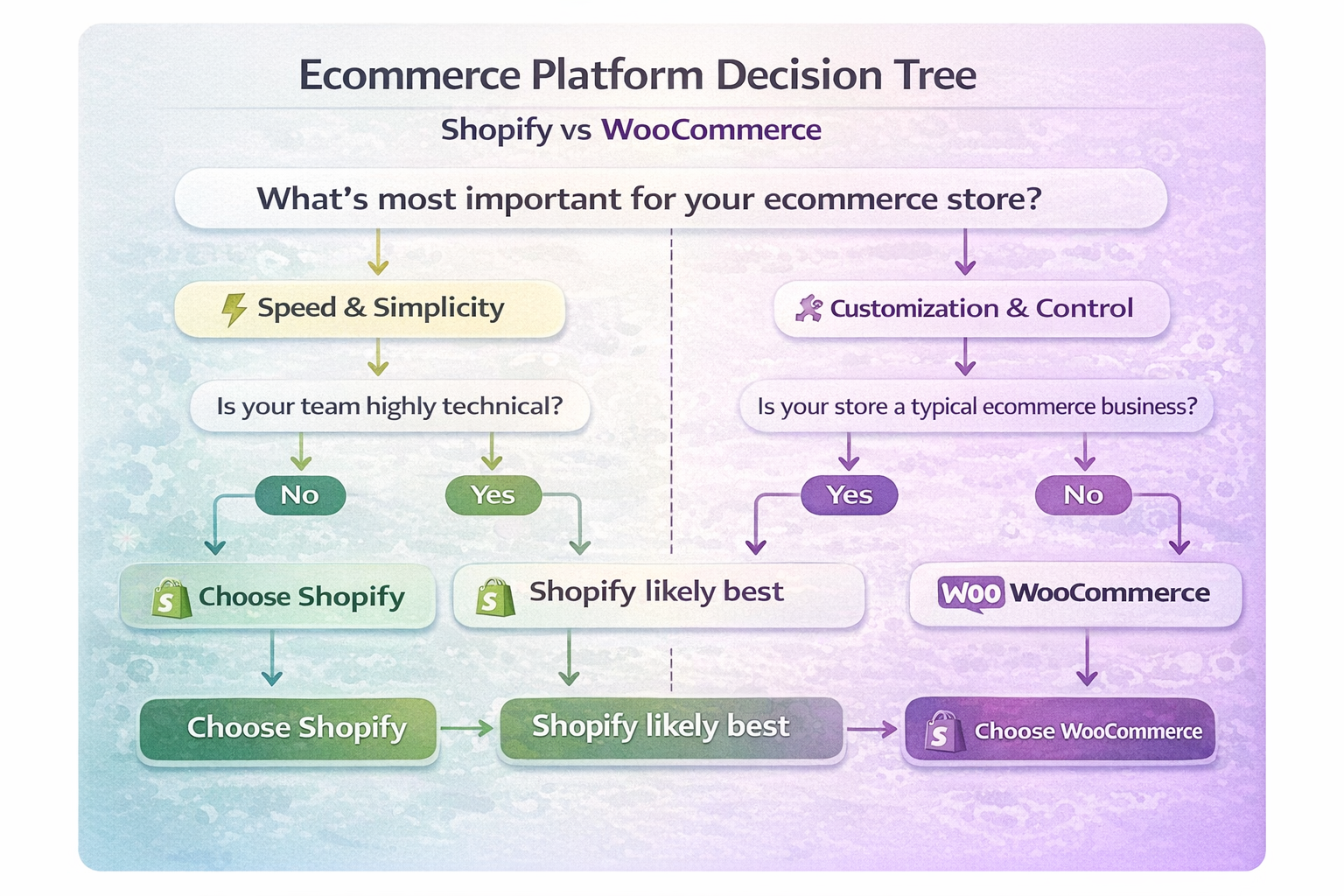
Choosing between Shopify and WooCommerce often comes down to how your business operates. The infographic below highlights the situations where each platform tends to outperform the other.
The visual below describes which platform is best based on what any given type of business needs
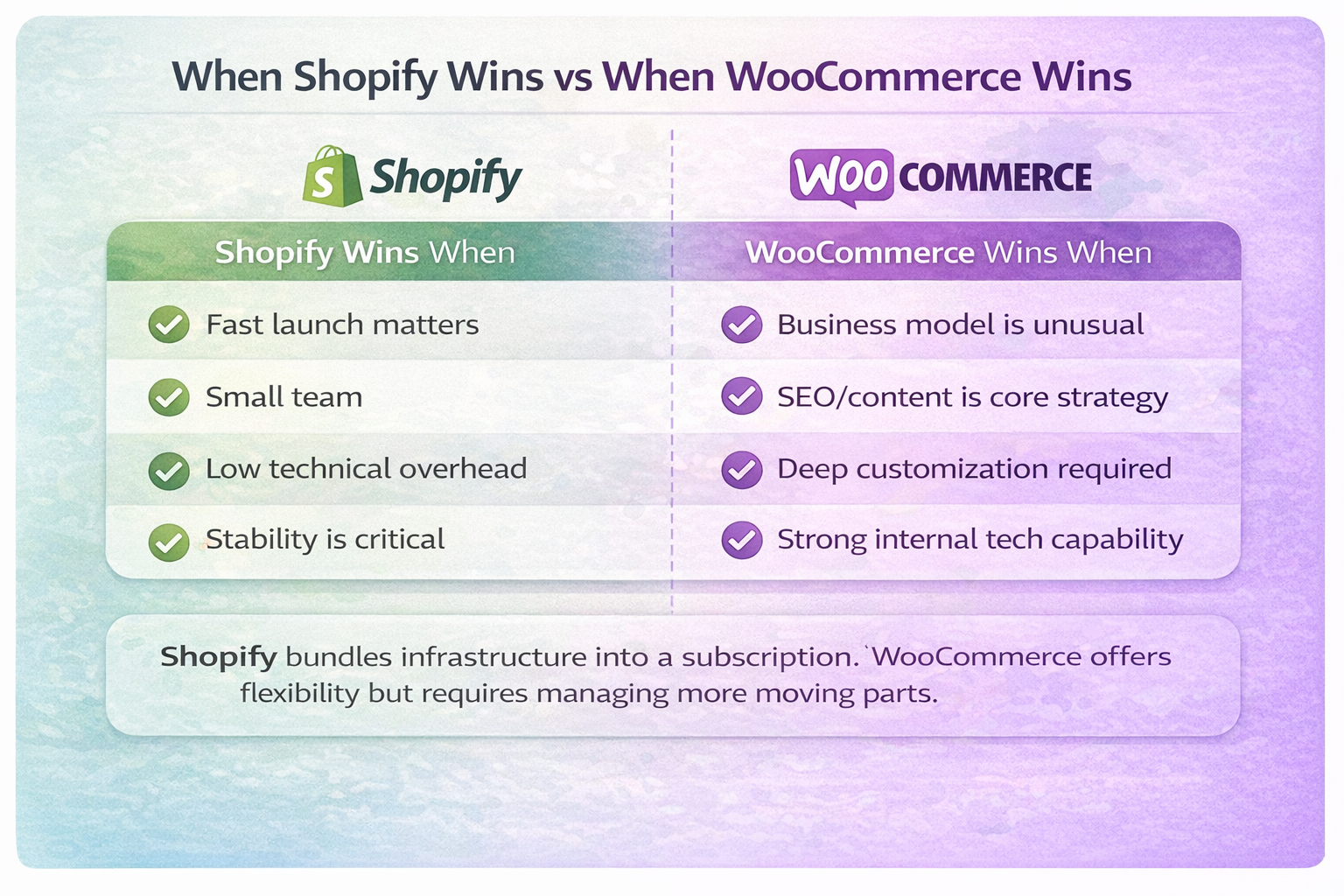
Shopify tends to win when speed, simplicity, and reliability matter most. WooCommerce shines when businesses require deep customization or unusual ecommerce architectures.
The real trick is choosing the one that matches how your business actually works.
Why Shopify Feels Simpler (And WooCommerce Feels More Flexible)
One of the biggest differences between Shopify and WooCommerce isn’t visible in the storefront. It’s in how the platforms are architected. Shopify bundles hosting, infrastructure, and the commerce engine into a single managed platform. WooCommerce runs on top of WordPress and hosting, which creates a layered stack with more flexibility but more moving parts.
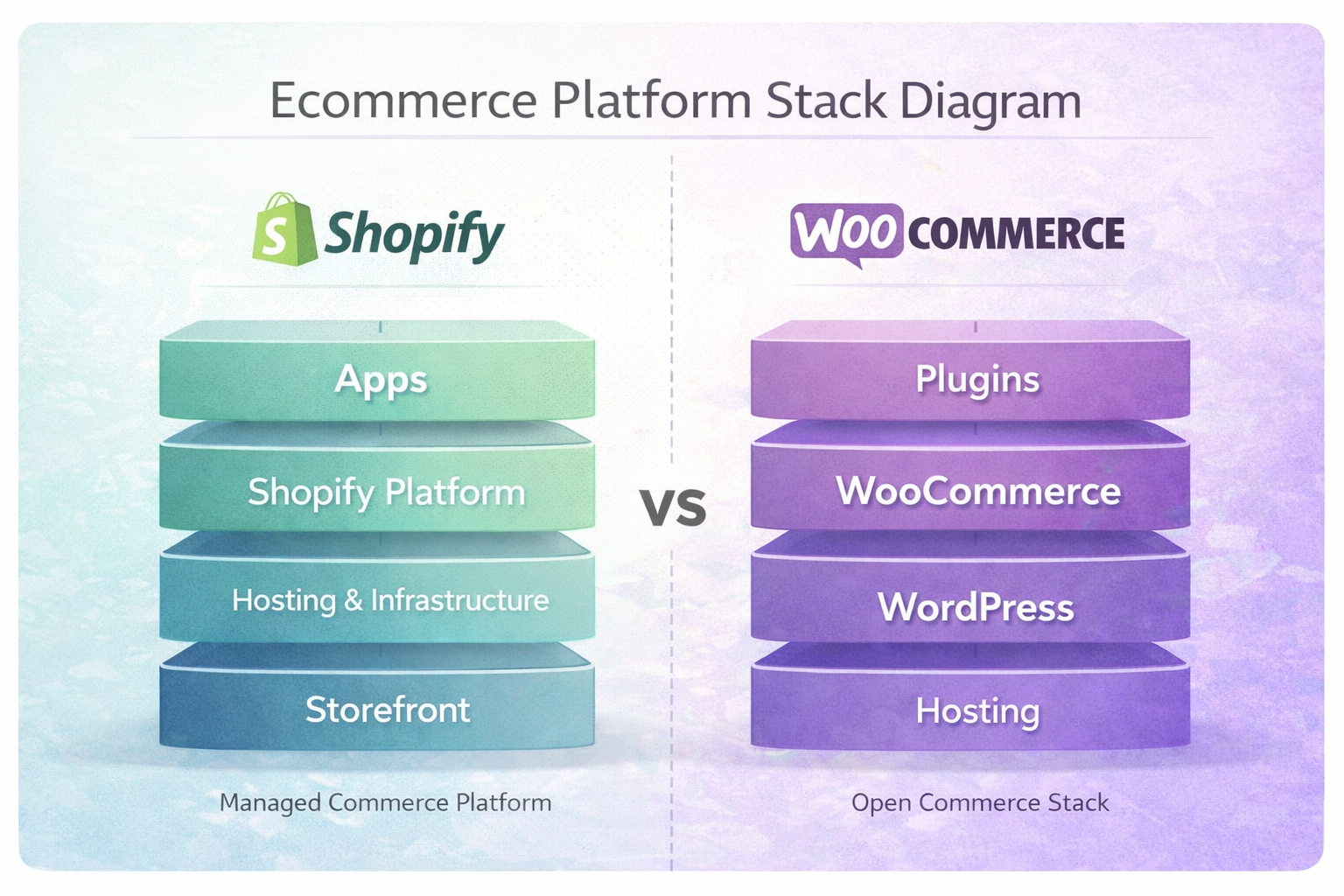
Shopify’s managed architecture removes much of the technical overhead required to run an ecommerce store. Updates, security, and infrastructure scaling are handled by the platform.
WooCommerce, on the other hand, sits within the WordPress ecosystem. That means the store is built from multiple layers: hosting, WordPress, the WooCommerce plugin, and additional extensions. This structure gives developers far more flexibility, but it also requires more technical management.
Final Thought
If your ecommerce store isn’t performing the way you expected, the issue is often not the platform itself.
It’s how the platform is being used.
Architecture, UX, conversion strategy, SEO structure, and marketing integration often matter far more than whether you chose Shopify or WooCommerce.
That’s where thoughtful strategy and good implementation make the difference.
And in 2026, those things matter more than ever.